
What Do Red And Green Mean On Velocity Radar?
On Doppler velocity radar, green shows motion toward the radar and red shows motion away, with brighter shades meaning faster speeds. Only motion along the beam is measured. Bright green and bright red side by side across the beam can mean rotation, but it must be checked across several scans and tilts.
Reflectivity tells you what is up there. Velocity tells you what it is doing, and that is where rotation hides. It looks like a bad holiday sweater at first. Give it ten minutes and it starts to make sense.
Key Takeaways
- Doppler radar measures only radial velocity, toward or away from the radar.
- Green is inbound, red is outbound, and brighter means faster.
- Speeds beyond the Nyquist velocity fold over and appear with the wrong sign.
- Purple haze marks range-folded gates the radar cannot place.
- A rotation couplet sits side by side across the beam; along-beam pairs mean convergence or divergence.
Reflectivity tells you what is in the air. Velocity tells you how the air is moving, and that is where you find rotation, damaging winds and boundaries. Velocity images are harder to read at first, but a few principles unlock them.
Why Does Velocity Radar Only Show Some Of The Wind?
Doppler radar measures Radial Velocity: the component of motion directly toward or away from the radar along the beam. Wind blowing straight across the beam gives zero radial velocity even if it is blowing 80 mph. So the same wind looks different depending on where it is relative to the radar.
What Do Red And Green Mean On Radar Velocity?
In LightningWX and most radar displays:
- Green (cool colors): motion toward the radar (negative values).
- Red (warm colors): motion away from the radar (positive values).
- Brighter shades mean faster speeds.
A handy memory aid: red means "receding," like a car's taillights moving away.
The Zero Isodop
Where the wind blows perpendicular to the beam, radial velocity is zero. The line of zero radial velocity is the zero isodop, often drawn as a gray band between green and red. Its shape tells you a lot:
- If the wind has the same direction at all heights, the zero line is straight through the radar.
- Because higher tilts sample higher altitudes farther from the radar, the zero line bends when wind direction changes with height. An S-shaped zero line (bending clockwise with distance) means winds veer with height, a sign of warm air advection. A reverse-S means backing and cold advection.
What Is Velocity Aliasing On Radar?
The radar measures phase shift between pulses, and phase repeats every full cycle. That sets a maximum speed the radar can measure unambiguously, the Nyquist Velocity. It depends on the wavelength and pulse repetition frequency; for the WSR-88D it is typically around 50 to 65 knots in precipitation modes.
Speeds faster than the Nyquist velocity fold into the opposite sign. An outbound wind of 70 knots with a 60-knot Nyquist limit appears as about 50 knots inbound. This is Velocity Aliasing (or folding). You spot it as bright red touching bright green with no gray zone in between, in a place where it makes no physical sense, such as in a smooth, strong wind field.
Dealiasing
Software can dealias the data by checking neighboring gates and adding or subtracting the correct multiple of the Nyquist interval. The WSR-88D uses advanced dealiasing algorithms, but they occasionally fail, especially in strong, tight rotation. When in doubt, compare the raw and dealiased views.
What Does Purple Mean On Velocity Radar?
There is a tradeoff. A higher pulse rate raises the Nyquist velocity but shortens the maximum unambiguous range, since the next pulse goes out before echoes from distant targets return. Echoes from beyond that range get placed at the wrong distance. When the radar cannot tell which range an echo belongs to, it marks those gates as range folded, displayed as a purple haze. That is Range Folding. Clear-air or split-cut scanning reduces it, but you will still see purple patches, especially with big storms at long range.
What Is Storm-Relative Velocity?
A storm moving 40 mph east adds 40 mph of motion to everything inside it. That makes rotation harder to see. Storm-Relative Velocity subtracts the storm's motion from each gate, showing the winds as a storm-riding observer would see them. Rotation then stands out as a clean pair of inbound and outbound colors.
Signatures To Know
Rotation: The Velocity Couplet
A Velocity Couplet is a tight area of strong inbound velocities right next to strong outbound velocities, lined up side by side across the beam (at the same distance from the radar). That means air is circulating.
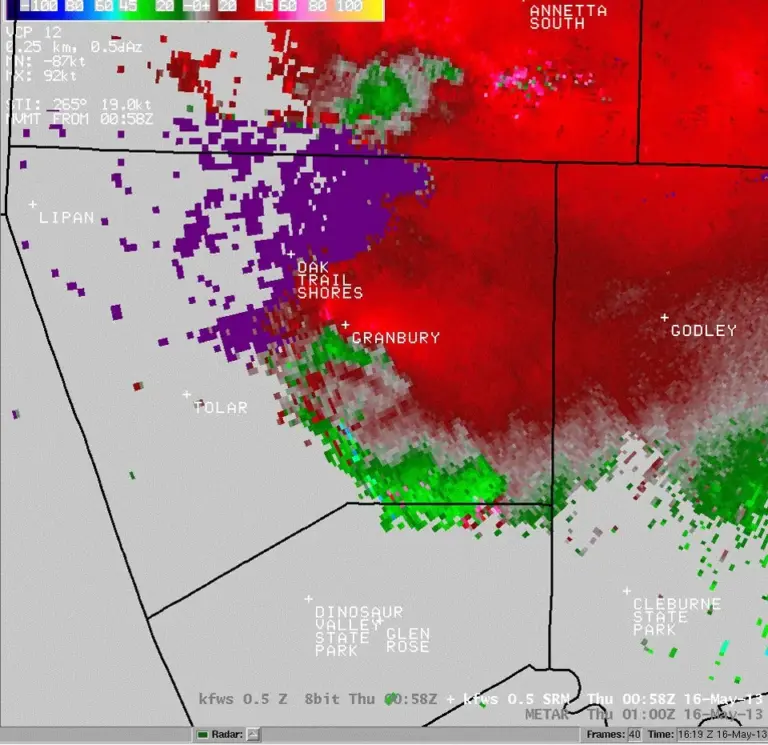
- In a Mesocyclone the couplet is several miles across.
- A tornado vortex signature is a very tight, intense couplet between adjacent gates.
- Strength is often judged by rotational velocity, half the difference between the maximum inbound and outbound speeds.
Convergence And Divergence
When the strong inbound and outbound values are lined up along the beam (one closer to the radar, one farther) instead of beside each other:
- Convergence: inbound values on the far side and outbound on the near side, air coming together. Common along fronts and gust fronts.
- Divergence: outbound on the far side and inbound on the near side, air spreading apart. Near the ground it signals a downburst; at storm top it shows a strong updraft venting out.
Other Features
- Rear-inflow jets in squall lines appear as bands of strong winds behind the leading edge, often leading to bow echoes.
- Low-level jets show as strong velocities in a ring at a certain range in the lowest tilts.
Try It Here
Real-World Example: Couplets Under The Hook
During major tornado events such as Moore, Oklahoma on May 20, 2013, forecasters watched a tight inbound and outbound couplet on low-tilt velocity, paired with a hook on reflectivity. The couplet sat across the beam, exactly the side-by-side pattern this lesson describes.
Here on the Space Coast, tropical rainbands during hurricane season can carry small, brief rotations. They are often tiny and quick, which is exactly why the lowest tilt and the closest radar matter so much.
Common Mistakes
- Myth: Any bright red touching bright green is a tornado. Fact: It can be aliasing, convergence, divergence or noise. Rotation is side by side across the beam and should persist over several scans and tilts.
- Myth: Velocity shows the true wind speed. Fact: It shows only the part of the wind along the beam, which is always less than or equal to the actual speed.
- Myth: Purple on velocity means extreme winds. Fact: Purple haze marks range-folded data the radar could not assign to a distance.
- Myth: A couplet means a tornado is on the ground. Fact: A couplet shows rotation in the beam, which may be thousands of feet up. Follow NWS warnings and confirmed reports.
Go Deeper: The Nyquist Interval And Rotational Velocity
The maximum unambiguous velocity is wavelength x PRF / 4, and the maximum unambiguous range is c / (2 x PRF). Multiply them and the PRF cancels: their product equals c x wavelength / 8. For a fixed wavelength you cannot raise one without lowering the other. That is the Doppler dilemma, and it is why a 10 cm S-band radar gets a more usable combination than shorter-wavelength C-band or X-band radars.
Rotational velocity is half the sum of the peak inbound and outbound speeds in a couplet. Its meaning depends on the couplet diameter and the range, because the 1-degree beam smears small circulations at distance. That is the problem normalized rotation products try to address.
Check Yourself
No grades, no sign-in. Pick an answer and see how you did. The app keeps score for you and tracks your progress.
1 On LightningWX velocity displays, green means:
Show The Answer
Motion toward the radar Green shades are inbound (negative) velocities; red shades are outbound.
2 What happens when winds exceed the Nyquist velocity?
Show The Answer
They fold over into the opposite direction (aliasing) Speeds beyond the Nyquist limit wrap around and appear with the wrong sign.
3 A rotation signature appears as strong inbound and outbound velocities:
Show The Answer
Side by side across the beam at the same range Side-by-side couplets across the beam indicate rotation; along-beam pairs indicate convergence or divergence.
4 What does purple haze on a velocity image mean?
Show The Answer
Range-folded data the radar cannot place correctly Purple marks gates where the radar cannot determine the correct range.
5 Why use storm-relative velocity?
Show The Answer
It subtracts storm motion so rotation stands out Removing the storm's movement reveals the internal circulation more clearly.
Questions People Ask
What does green mean on velocity radar?
Green means motion toward the radar, shown as negative values. Brighter green means faster inbound speeds.
How do you spot a tornado on velocity radar?
Look for a tight area of strong inbound and outbound velocities side by side across the beam, ideally on the lowest tilt close to the radar, persisting across scans. Only the NWS issues tornado warnings.
What is the zero isodop?
It is the line of zero radial velocity, where the wind blows across the beam. An S shape means winds veer with height; a reverse S means they back.
Why use storm-relative velocity?
It subtracts the storm's own motion so rotation inside the storm stands out more clearly.
Learn More From The Experts
- Radar Images: Velocity NOAA / NWS
- JetStream Max: Volume Coverage Patterns NOAA / NWS
- Severe Weather 101: Tornado Detection NOAA NSSL
Red means receding. Say it out loud a few times. The neighbors already think spotters are odd. - Jen — Jen
