
What Is Earth's Energy Budget?
Earth's energy budget is the balance between sunlight the planet absorbs and infrared energy it sends back to space. About 30 percent of incoming sunlight is reflected, roughly 20 percent is absorbed by the atmosphere and 50 percent by the surface. Over time Earth emits nearly as much as it absorbs, about 240 watts per square meter.
Every storm starts as sunlight. That sounds like a fortune cookie, but it is just physics. This lesson follows the sun's energy in and Earth's energy out, and it ends at my favorite part, latent heat, the hidden fuel inside every thunderstorm.
Key Takeaways
- Hotter objects emit shorter wavelengths, so sunlight is shortwave and Earth's emission is longwave infrared.
- Earth reflects about 30 percent of incoming sunlight, an albedo of about 0.30.
- Fresh snow reflects 80 to 90 percent of sunlight, while open ocean with high sun reflects under 10 percent.
- Latent heat carries about three times more energy from the surface to the atmosphere than sensible heat.
- Condensing vapor releases latent heat that powers thunderstorms and hurricanes.
Nearly all the energy that powers weather arrives from the sun. What happens to that energy, how much is reflected, absorbed, stored and eventually sent back to space, is called Earth's Energy Budget. Understanding it explains why the ground warms, why clouds can both warm and cool, and where storms get their fuel.
Why Is Sunlight Called Shortwave Radiation?
Every object with a temperature above absolute zero emits electromagnetic radiation. Two physical laws describe how:
- Stefan-Boltzmann law: The total energy emitted rises with the fourth power of absolute temperature. Double the temperature in kelvins and the emission rises sixteenfold.
- Wien's law: Hotter objects emit at shorter wavelengths. The peak wavelength is inversely proportional to temperature.
The sun's surface is about 5,800 K, so it emits most strongly in visible light, around 0.5 micrometers. Earth's surface averages about 288 K (15 C, 59 F), so it emits mostly infrared around 10 micrometers. That difference is so clean that meteorologists split the spectrum in two:
- **Shortwave Radiation:** Incoming sunlight, including ultraviolet, visible and near-infrared, mostly shorter than 4 micrometers.
- **Longwave Radiation:** Infrared emitted by the Earth, its atmosphere and clouds, mostly longer than 4 micrometers.
Incoming Sunlight
At the top of the atmosphere, sunlight delivers about 1,361 watts per square meter on a surface facing the sun, a value called the solar constant. Averaged over the whole spinning globe, day and night, that comes to about 340 W/m2.
Of that incoming sunlight, on a global average:
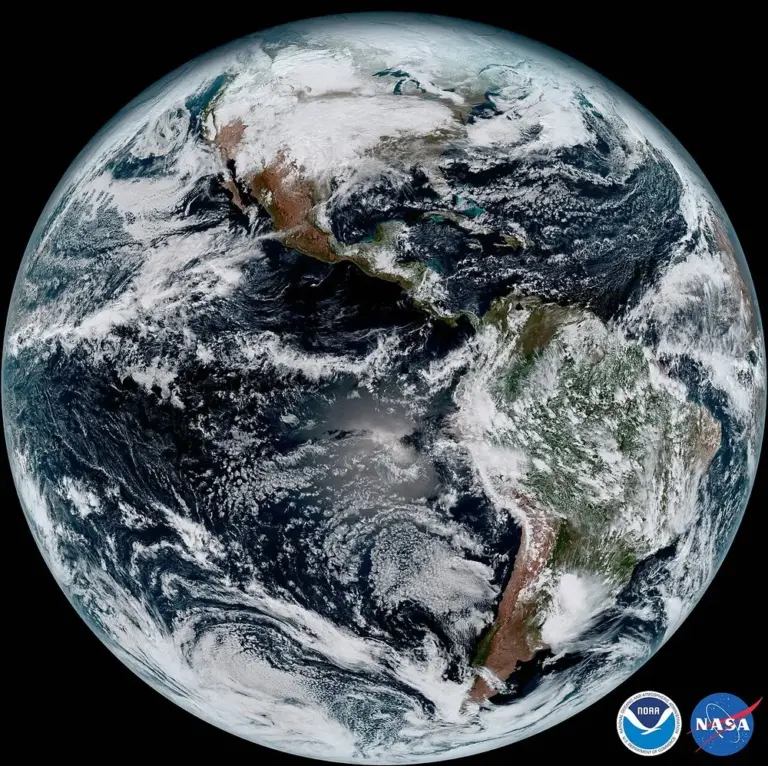
- About 30 percent is reflected back to space by clouds, aerosols, air molecules and bright surfaces.
- About 20 percent is absorbed by the atmosphere, mostly by ozone, water vapor and clouds.
- About 50 percent is absorbed at the surface, warming land and ocean.
Air molecules scatter short blue wavelengths more than red ones, a process called Rayleigh scattering. That is why the sky is blue and sunsets, whose light travels through much more air, turn orange and red.
What Is Albedo?
Albedo is the fraction of incoming sunlight a surface reflects. Earth's overall albedo is about 0.30. Individual surfaces vary widely:
- Fresh snow: 0.80-0.90
- Thick clouds: 0.60-0.90
- Desert sand: 0.30-0.40
- Grass and farmland: 0.15-0.25
- Forest: 0.10-0.20
- Open ocean with high sun: under 0.10
Albedo creates powerful feedbacks. Fresh snow cover reflects most sunlight, so snowy ground stays colder, which helps preserve the snow. As sea ice melts, darker water absorbs more energy and melts more ice. Forecasters know that a fresh snowpack can keep afternoon highs 5-10 C colder than models without snow would predict.
Outgoing Longwave Radiation
The warmed surface emits longwave radiation upward. Most of it does not escape directly. Water vapor, carbon dioxide, methane and clouds absorb much of it and re-emit energy in all directions, including back down toward the ground. This back radiation is why cloudy nights stay warmer than clear ones. The process, the greenhouse effect, gets its own lesson.
Averaged over years, Earth sends back to space almost exactly as much energy as it absorbs, about 240 W/m2. A small current imbalance of roughly 1 W/m2, caused by rising greenhouse gases, is slowly warming the planet, mostly in the oceans.
How The Surface Gets Rid Of Heat
If the ground only lost energy by radiation, it would become far hotter during the day. Instead, the surface passes energy to the atmosphere in three ways:
- Net longwave radiation: The surface emits more infrared than it receives back.
- **Sensible Heat:** Heat you can feel and measure with a thermometer, passed to the air by conduction and carried upward by convection. It dominates over dry deserts.
- **Latent Heat:** Energy used to evaporate water from oceans, soil and plants. It does not raise the temperature at the surface; instead, it travels hidden in water vapor.
What Is Latent Heat in Weather?
Evaporating one gram of water takes about 2,500 joules. That energy is stored in the vapor and released when the vapor condenses back into cloud droplets, anywhere from a few hundred meters to 15 km above the ground. Globally, latent heat carries about three times more energy from the surface to the atmosphere than sensible heat does.
This is the engine of storms. Every thunderstorm and hurricane is powered by latent heat released inside its cloud, which warms the rising air, keeps it buoyant and lets it climb faster. A single thunderstorm can release as much energy as several atomic bombs over its lifetime, almost all of it from condensing vapor.
Why Does the Energy Budget Matter for Weather?
The global budget balances, but locally it does not. Some places absorb more than they emit, others the reverse. The atmosphere and ocean respond by moving heat from surplus regions to deficit regions, and that motion is what we call weather. The rest of this unit explores where the surpluses and deficits are, and why.
Real-World Example: Watching Storms on Infrared at Night
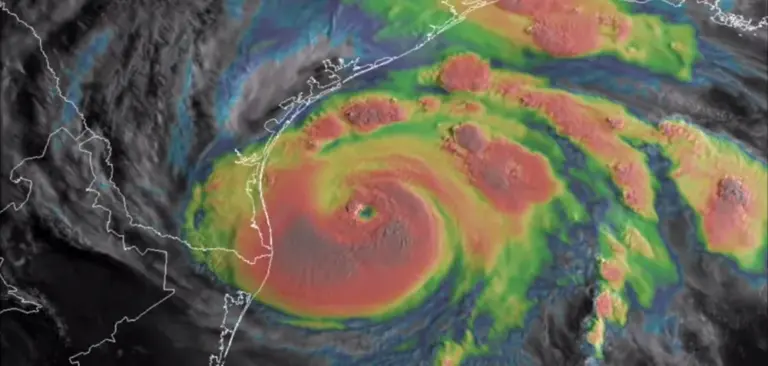
After sunset the visible satellite view goes dark, but storms keep going. Infrared imagery measures the longwave radiation everything emits, day or night. Tall thunderstorm tops are very cold, so they emit less and show up as bright white or brightly colored areas.
That is the energy budget on your screen. The coldest, tallest tops mark the strongest updrafts, where the most vapor is condensing and releasing latent heat.
Common Mistakes
- Myth: Clouds only cool the Earth by blocking the sun. Fact: Clouds reflect sunlight, which cools, but they also absorb infrared and send some back down, which is why cloudy nights stay warmer.
- Myth: Evaporation heats the ground. Fact: Evaporation absorbs energy. That energy rides along in the vapor and is released as heat when it condenses in a cloud.
- Myth: Earth absorbs all the sunlight that reaches it. Fact: About 30 percent is reflected back to space by clouds, aerosols, air molecules and bright surfaces.
Go Deeper: Stefan-Boltzmann, Wien and the 240 W/m2 Balance
The Stefan-Boltzmann law says total emission scales with the fourth power of absolute temperature, and Wien's law says peak wavelength is inversely proportional to temperature. With the sun near 5,800 K and Earth's surface near 288 K, the two spectra barely overlap, which is why meteorologists can split radiation cleanly at about 4 micrometers.
The globally averaged incoming sunlight of about 340 W/m2 is one quarter of the 1,361 W/m2 solar constant, because a sphere has four times the area of the disk that intercepts sunlight. After about 30 percent is reflected, roughly 240 W/m2 is absorbed, and over the long term Earth radiates about the same amount back to space. The current imbalance of roughly 1 W/m2 is warming the planet, mostly in the oceans.
Check Yourself
No grades, no sign-in. Pick an answer and see how you did. The app keeps score for you and tracks your progress.
1 Why is the sun's radiation called shortwave and Earth's called longwave?
Show The Answer
Hotter objects emit at shorter wavelengths Wien's law says peak emission wavelength shrinks as temperature rises; the 5,800 K sun peaks in visible light.
2 Which surface has the highest albedo?
Show The Answer
Fresh snow Fresh snow reflects about 80 to 90 percent of incoming sunlight.
3 What happens to the energy used to evaporate water at the surface?
Show The Answer
It is released as latent heat when the vapor condenses Latent heat is carried aloft in water vapor and released inside clouds, powering storms.
4 Roughly what fraction of incoming sunlight does Earth reflect back to space?
Show The Answer
About 30 percent Earth's planetary albedo is about 0.30, mostly due to clouds.
Questions People Ask
What is albedo?
Albedo is the fraction of sunlight a surface reflects. Earth's overall albedo is about 0.30, fresh snow is 0.80 to 0.90, and open ocean with high sun is under 0.10.
Why is the sky blue?
Air molecules scatter short blue wavelengths more than red ones, called Rayleigh scattering. At sunset light passes through much more air, so the colors turn orange and red.
What is the difference between latent heat and sensible heat?
Sensible heat is heat you can measure with a thermometer. Latent heat is energy stored in water vapor during evaporation and released when the vapor condenses.
Where do thunderstorms get their energy?
Mostly from latent heat released as water vapor condenses inside the cloud, which warms the rising air and keeps it buoyant.
Learn More From The Experts
Every lightning bolt you have ever seen was sunlight first. Kind of romantic, for physics. — Jen
