
Rare Air and Raw Science Data: What I Am Building Next
Confession time. I have two new modules open on my screen right now, and neither one is finished. That’s the most honest way I know to start a post about software, so here we are. This is a look at what I’m building, what’s going in first, what has to wait, and why I’d rather make you wait than ship you a pretty number I can’t back up.
Both modules are part of the LightningWX subscription, and both are coming in an upcoming update. They aren’t in the software you can download today. I’m telling you about them now because I want your eyes on them before they ship, and because I physically cannot keep a nerdy secret.
Module One: Rare Air
Rare Air forecasts the strange and overlooked side of the sky. The stuff most weather apps skip because there’s no siren attached to it: halos around the sun, sun dogs, light pillars over a frozen parking lot, hair ice growing on a dead branch. Weather that makes you stop in the driveway and say “wait, what is that?”
What’s in the First Version
Twenty phenomena, scored from data LightningWX already pulls in (model soundings, surface observations, sun and moon position, and the space weather index):
- Sky Optics: 22° halos, sun dogs, light pillars, the circumzenithal arc and fogbows
- Winter Weirdness: thundersnow, graupel, freezing fog, diamond dust, hoar frost and rime, hair ice and frost flowers
- Waves In The Air: mountain waves and lenticular clouds, Kelvin-Helmholtz wave clouds, and gravity waves and undular bores
- Wind And Water: heat bursts, steam devils and sea smoke
- Way Up High: noctilucent clouds and the aurora
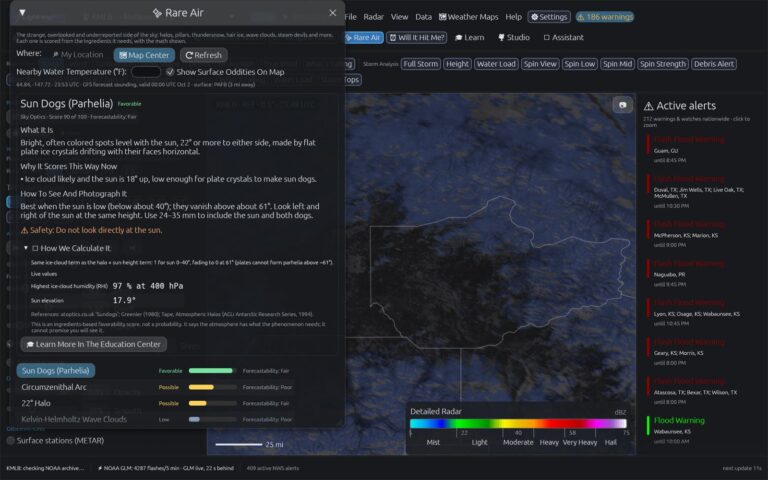
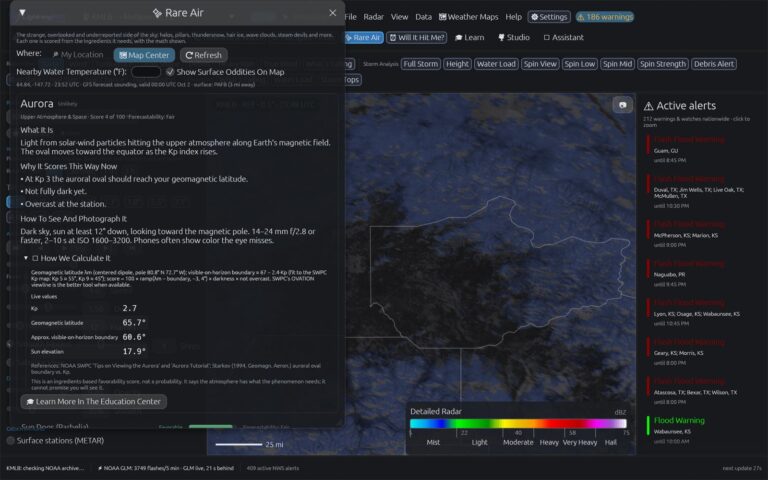
Every card has a section called How We Calculate It. It shows the formula, the live values that went into it, and the references the rule came from. If Rare Air says sun dogs look favorable, you can see that the ice-cloud humidity is 97% at 400 hPa and the sun is 18° up, and decide for yourself whether you buy it.
And here’s the part I care about most. The scores are ingredient scores from 0 to 100. They are not probabilities. A score of 80 means the atmosphere has what the phenomenon needs. It doesn’t mean there’s an 80% chance you’ll see it. Diamond dust needs severe cold, near-saturated air, clear sky and light wind, and Rare Air can tell you all four are there. It can’t promise a crystal floats past your porch light. I’d rather say that out loud than dress it up.
Each card also has photo tips, because I’m a lightning photographer and I can’t help myself: when to look, which way to point, what lens and exposure to start with. Where there’s a safety issue, like not staring at the sun to find a halo, the card says so plainly.
There’s also a new Education Center unit, Strange And Overlooked Weather, with lessons on the optics, the ice and the waves, a quiz for each, and new glossary terms. Every Rare Air card has a button that takes you straight to the lesson. Because a weather nerd is just a curious person who kept asking “but why?”
What Has to Wait
My list of weird weather is a lot longer than twenty. Some of it has to wait, because forecasting it honestly takes data LightningWX doesn’t have yet. I’m not going to guess and call it a forecast. Here’s what’s on the bench and the data each one needs:
- Buoy and lake water temperatures for sea smoke and steam devils. Right now you type in the water temperature yourself. Automatic is better.
- Terrain for mountain waves. Without it, a mountain-wave score far from any mountains means nothing, and the card tells you that.
- Soil temperature and moisture for frost quakes and frost flowers.
- Water-level gauges for meteotsunamis and seiches.
- Stratospheric temperatures for nacreous clouds.
- Lightning polarity for sprites.
- Dust and fire feeds for haboobs and fire whirls.
- Snowpack and river ice for snow rollers and ice shoves.
Then there are the ones that stay educational. The green flash, mirages, glories and St. Elmo’s fire get lessons and explanations, but the models can’t see the tiny details they depend on, so they get no score. Ball lightning can’t be forecast by anybody. If someone tells you they can forecast ball lightning, smile politely and back away slowly.
One more honest thing: the scores still need to be checked against real sightings. I plan to test them against what weather stations actually report over a winter, starting with freezing fog, diamond dust and thundersnow. Your reports will help too. If Rare Air says hoar frost is favorable and your yard looks like a frosted cake, I want to know. If it says favorable and you get nothing, I want to know that even more.
Module Two: Raw Science Data
This one is for the people who read the math in Rare Air and think, “Cute. Now give me the numbers.”
Raw Science Data shows every live metric LightningWX uses to forecast, updating as the data arrives: radar, storm cells, lightning, alerts, surface observations, the national radar mosaic, model data, cloud-top cooling, space weather, the tropics, your home weather station and the analysis tools. All of it, in one searchable table. The point is simple. You should be able to research the weather and test your own methods with the same data my tools use.
- Every metric gets a time-series chart and a definition, so you know what a number means before you build a theory on it.
- CSV export for a period you choose, or everything that’s been recorded. Exporting is for subscribers.
- Huge radar and model grids get summaries (maximum, mean, coverage) plus values at the points you care about, like home, a spot you pick on the map, or a tracked storm. When you want the whole thing, you can export the current grid.
Don’t be like me and build a whole theory about a storm at 2 AM before checking what the numbers actually said. You open Raw Science Data, chart it, export it and test it. Then you can come tell me I’m wrong, with evidence. I’ll enjoy that more than you think.
What Makes LightningWX Different
I’m not going to trash anybody’s app. Plenty of weather software is good at what it does. I’ll just tell you what I built LightningWX to do, and you can decide.
- It shows its math. Rare Air’s How We Calculate It and Raw Science Data both come from the same belief: you should be able to see why the software says what it says. No black box.
- It’s built by someone who stands out in the storms. I’m a trained NWS SKYWARN storm spotter and a lightning photographer. I’m the human lightning rod so you don’t have to be. Don’t be like me, standing in the yard for one more bolt. When thunder roars, you go indoors and watch the strikes on LightningWX.
- It runs on government data. NOAA, the National Weather Service, NASA and USGS. Public science, paid for by all of us, put to work.
- Some things never go behind the subscription. Lightning data, NWS watches and warnings, and Basic Radar stay with your software forever, with or without a subscription. Warnings save lives. They don’t belong behind a paywall.
- The Education Center is real lessons. Units, lessons, quizzes, a final exam and a glossary of around 490 terms, with buttons that open the tool each lesson is about.
- The forecasting learns. GenAvaM, my own model, checks its lightning forecast against real lightning after every radar scan and gets better at your radar over time. It’s part of the subscription.
- One license, plus a subscription for premium tools. You buy the software once. The subscription unlocks the premium tools, like these two modules.
- You can ask for features. If you own LightningWX and want something, message me. If it’s interesting and nerdy enough, I’m happy to oblige. Rare Air exists because I wanted it, and I’m guessing I’m not the only one.
One serious note, because it matters: LightningWX is a tool for learning and watching weather. It is not an official warning source. When the National Weather Service issues a warning for your area, follow it and your local emergency officials.
That’s where both modules stand. Rare Air and Raw Science Data are coming in an upcoming update, and I’ll post again when they’re ready. Until then, keep an eye on the sky. Sometimes it does something strange, and now I want software that tells me when.
Red hair, a mountain of half-tested code and a sky full of weird stuff. I wouldn’t have it any other way.
— Jen
