
What Are the Layers of the Atmosphere in Order?
From the ground up, the main layers are the troposphere, stratosphere, mesosphere and thermosphere, with the thin exosphere fading into space above. Scientists separate them by how temperature changes with height. Nearly all weather happens in the troposphere, which holds about 80 percent of the air's mass and almost all of its water vapor.
All the weather you have ever seen happens in a layer of air thinner than a coat of paint on a basketball. That still blows my mind. Here is what the air is made of, and why meteorologists slice it into layers by temperature.
Key Takeaways
- Dry air is about 78 percent nitrogen, 21 percent oxygen and just under 1 percent argon, with carbon dioxide near 0.04 percent.
- Water vapor varies from nearly zero to about 4 percent, and it is the gas that matters most for weather.
- The atmosphere's layers are defined by whether temperature falls or rises with height.
- The troposphere holds about 80 percent of the atmosphere's mass and nearly all weather.
- The tropopause acts like a lid, which is why thunderstorm anvils flatten out on top.
Every thunderstorm, snowflake and sea breeze happens inside a surprisingly thin shell of gas. If Earth were the size of a basketball, the part of the atmosphere where weather happens would be thinner than a coat of paint. This lesson covers what that gas is made of and how it is organized into layers.
What Is Air Made Of?
Dry air is a mixture of gases that stays remarkably constant in proportion from the ground up to about 80 km (50 miles):
- Nitrogen (N2): about 78 percent by volume
- Oxygen (O2): about 21 percent
- Argon (Ar): about 0.93 percent
- Carbon dioxide (CO2): about 0.04 percent (roughly 420 parts per million, and rising)
- Trace gases: neon, helium, methane, krypton, hydrogen, ozone and others
Then there is the ingredient that matters most for weather: water vapor. It is not included in the "dry air" list because it varies enormously, from nearly zero in polar deserts to about 4 percent in steamy tropical air. Water vapor is invisible; clouds and fog are liquid droplets or ice crystals, not vapor. When vapor condenses it releases Latent Heat, the fuel behind storms and hurricanes.
The atmosphere also carries aerosols: dust, sea salt, smoke, pollen and sulfate particles. Many of these act as Condensation Nuclei, tiny surfaces on which cloud droplets form. Without them, clouds would struggle to form at all.
How Are the Layers of the Atmosphere Defined?
Meteorologists divide the atmosphere by how temperature changes with height. The rate at which temperature falls as you climb is called the Lapse Rate. Where the trend reverses, a new layer begins.
The Troposphere
The Troposphere runs from the ground to about 8 km (26,000 feet) over the poles and about 16-18 km (52,000-59,000 feet) over the tropics. It holds roughly 80 percent of the atmosphere's mass and nearly all of its water vapor, so almost all weather happens here. Temperature falls with height at an average of about 6.5 degrees C per kilometer (about 3.6 degrees F per 1,000 feet), because the ground is the main heater; sunlight warms the surface, and the surface warms the air above it. The word comes from the Greek tropos, "turning," which fits a layer that is constantly overturning.
The Tropopause
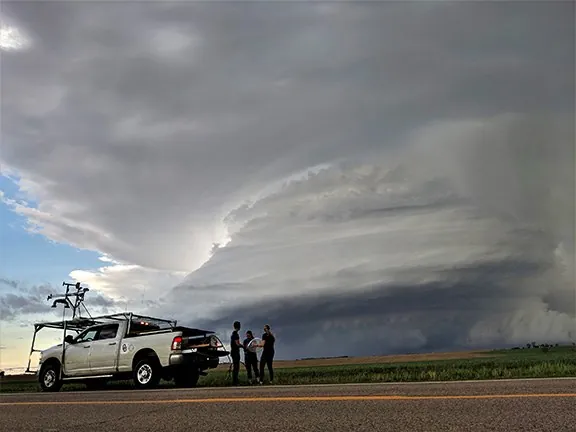
The Tropopause caps the troposphere. Above it, temperature stops falling and eventually begins to rise. That makes the tropopause behave like a lid: rising air loses its buoyancy there. The flat, spreading top of a thunderstorm anvil is the storm hitting this lid. The strongest winds of the Jet Stream are usually found just below it.
The Stratosphere
The Stratosphere extends from the tropopause to about 50 km (31 miles). Temperature here increases with height, which is an inversion that makes the layer very stable, with little vertical mixing. The warming comes from the ozone layer, which absorbs ultraviolet sunlight, most strongly between about 20 and 30 km. That absorption protects life at the surface. Only the most violent storms push an overshooting top briefly into the lower stratosphere.
The Mesosphere
From about 50 to 85 km (31 to 53 miles), temperature falls again with height, reaching the coldest natural temperatures on Earth, near -90 degrees C (-130 degrees F), at the mesopause. Most meteors burn up in the Mesosphere, and rare noctilucent clouds glow here on summer nights at high latitudes.
The Thermosphere
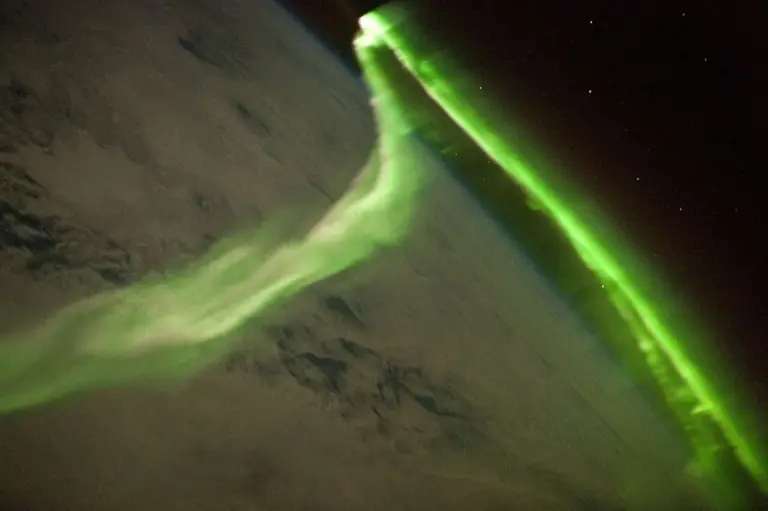
Above about 85 km, the Thermosphere absorbs intense solar X-ray and extreme ultraviolet energy. Its temperature can exceed 1,000 degrees C, yet it would not feel hot, because the air is so thin that very few molecules strike you. The aurora and the International Space Station both live here.
Why Do the Atmosphere's Layers Matter for Weather?
- Storm height: A storm can only grow as tall as the tropopause allows. Tall winter tropopauses are rare, so winter storms are usually shallower than summer ones.
- Stability: Anywhere temperature rises with height, air resists vertical motion. Low-level inversions trap fog, smog and cold air near the ground.
- Measuring it: Twice a day, National Weather Service offices launch weather balloons that measure temperature, humidity and wind up through the troposphere and into the stratosphere. These profiles are the backbone of every forecast.
Real-World Example: The Anvil Over a Florida Storm
On a summer afternoon on the Space Coast, thunderstorms boil up fast. Watch one from a safe distance and you will see the top stop climbing and spread sideways into a flat anvil. That is the storm hitting the tropopause, where the air stops getting colder with height and rising air loses its push.
Sometimes a lumpy dome pokes above the anvil for a few minutes. That is an overshooting top, a sign of a very strong updraft punching briefly into the lower stratosphere.
Common Mistakes
- Myth: Clouds and fog are water vapor. Fact: Water vapor is invisible. Clouds and fog are tiny liquid droplets or ice crystals that formed when vapor condensed.
- Myth: Air gets steadily colder the higher you go, all the way to space. Fact: Temperature falls through the troposphere, rises through the stratosphere, falls again in the mesosphere and rises in the thermosphere. Those reversals define the layers.
- Myth: The thermosphere would feel hot because it can top 1,000 degrees C. Fact: The air there is so thin that very few molecules strike you, so it would not feel hot.
Go Deeper: Why the Stratosphere Warms
The stratosphere warms with height because ozone absorbs ultraviolet sunlight and turns it into heat, most strongly between about 20 and 30 km. That warm-over-cold arrangement is an inversion, so the stratosphere is very stable and mixes vertically very slowly.
The troposphere is the opposite. It is heated from below by the ground, so it constantly overturns, which is where its name, from the Greek tropos for turning, comes from. The tropopause sits higher over the warm tropics, about 16 to 18 km, than over the poles, about 8 km, and the strongest jet stream winds usually run just below it.
Check Yourself
No grades, no sign-in. Pick an answer and see how you did. The app keeps score for you and tracks your progress.
1 Which gas makes up the largest share of dry air?
Show The Answer
Nitrogen Nitrogen makes up about 78 percent of dry air by volume, with oxygen about 21 percent.
2 How are the layers of the atmosphere defined?
Show The Answer
By how temperature changes with height Each boundary marks a reversal in the temperature trend, such as the tropopause where cooling stops.
3 Why does temperature rise with height in the stratosphere?
Show The Answer
Ozone absorbs ultraviolet sunlight Ozone absorbs UV radiation, heating the layer from within and making it very stable.
4 What visible feature shows a thunderstorm reaching the tropopause?
Show The Answer
A flat, spreading anvil Rising air loses buoyancy at the stable tropopause and spreads outward, forming the anvil.
5 Roughly what share of the atmosphere's mass is in the troposphere?
Show The Answer
About 80 percent Gravity compresses air near the surface, so the thin troposphere holds about 80 percent of the mass.
Questions People Ask
What layer of the atmosphere do we live in?
We live in the troposphere, the lowest layer. It runs from the ground to about 8 km over the poles and 16 to 18 km over the tropics, and it is where nearly all weather happens.
Which layer of the atmosphere has the ozone layer?
The stratosphere. Ozone there absorbs ultraviolet sunlight, which warms the layer and protects life at the surface.
In which layer do meteors burn up?
Most meteors burn up in the mesosphere, roughly 50 to 85 km above the ground.
Where does the aurora happen?
The aurora glows in the thermosphere, roughly 100 to 300 km up, the same layer where the International Space Station orbits.
What percent of air is oxygen?
About 21 percent of dry air is oxygen. Nitrogen makes up about 78 percent.
Learn More From The Experts
Next time you see an anvil, give the tropopause a little nod. It is doing its job. — Jen
